

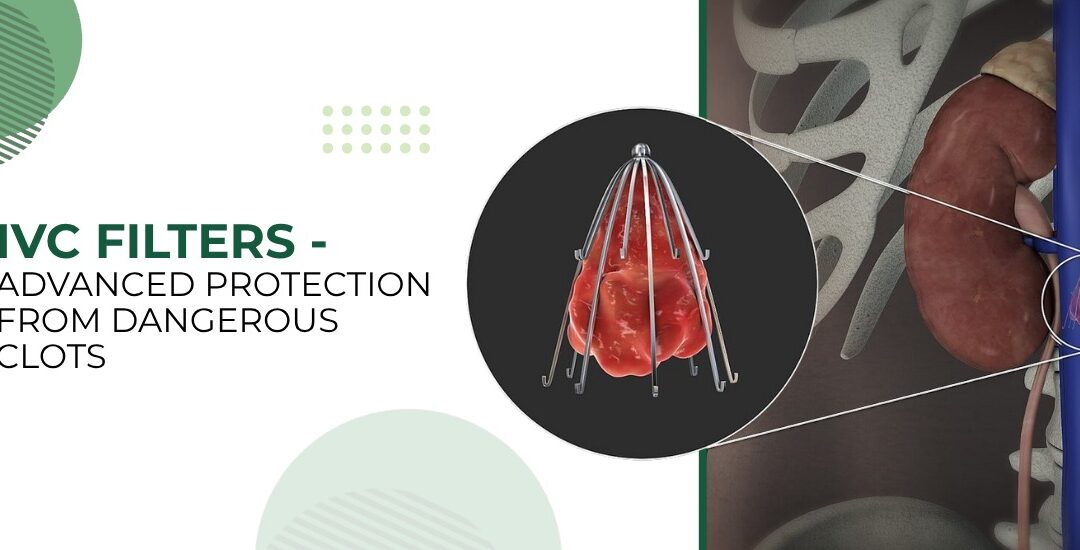
Every year, thousands of patients face a silent but devastating threat — a blood clot forming deep inside a vein, growing quietly, waiting to break free. When it does, it can travel straight to the lungs and turn into a pulmonary embolism — a medical emergency that can turn fatal within minutes. For patients who are at high risk, there’s a device that acts as the last line of defence: the IVC filter. Tiny enough to pass through a vein, yet powerful enough to stop a dangerous clot in its tracks, this life-saving intervention is made possible through Interventional Radiology, where advanced imaging guides doctors to treat conditions from within the body without major surgery. Understanding this device could genuinely save your life.
According to Dr. Aniruddha Kulkarni:
“In many high-risk patients, especially those who cannot take blood thinners, an IVC filter becomes a critical safeguard. Through interventional radiology, we can place it with precision and minimal discomfort, often in under an hour, offering protection when it matters the most.”
The Silent Danger Inside Your Veins — And What an IVC Filter Actually Does
If you’ve been told you need an IVC filter, your very first question is probably: what exactly is going inside my body? It’s a completely natural reaction — and the answer is far less intimidating than most people expect.
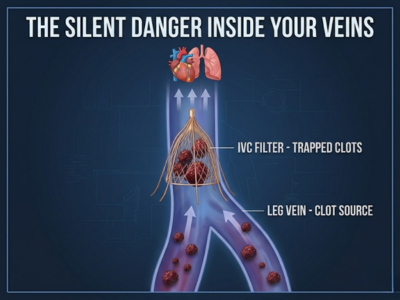
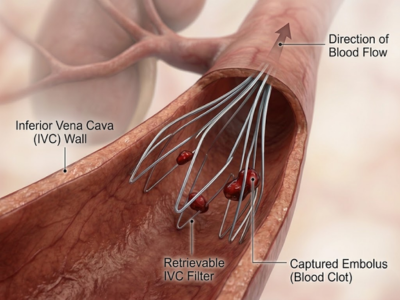
An Inferior Vena Cava (IVC) filter is a small, cage-like metallic device shaped a bit like a cone or an open umbrella, placed inside the inferior vena cava, the largest vein in your body. This vein runs through your abdomen and carries blood from your legs and lower body up to your heart and lungs. In some situations, especially in people dealing with serious conditions like liver cancer, the chances of developing blood clots can go up, which is why having this added layer of protection can make a real difference.
Here’s the danger it guards against: when a blood clot forms in the deep veins of your legs or pelvis — called deep vein thrombosis (DVT) — a fragment of that clot can break loose and travel upward through this very vein. If it reaches the lungs, it causes a pulmonary embolism (PE) — and that can be instantly fatal.
The IVC filter acts like a physical safety net. It sits inside the vein, catches those rogue clot fragments before they can make that dangerous journey, and lets normal blood flow continue around it. It doesn’t dissolve clots — it stops them from going somewhere they shouldn’t.
Most filters are made from titanium or nitinol, a nickel-titanium alloy. Both are biocompatible — meaning your body accepts them without rejection or inflammation.
Not Everyone Needs One — Here's Exactly Who Does and Why

IVC filters are not prescribed casually. They are recommended for a defined group of patients where the clot risk is high and either medication isn’t safe, or it simply isn’t enough on its own.
- You have a confirmed DVT or PE — but blood thinners aren’t an option. This is the most common scenario. If you’re actively bleeding internally, recovering from a recent surgery, or have a condition where anticoagulation would put you at serious haemorrhagic risk, a filter provides mechanical protection without triggering a bleeding crisis.
- You’ve had a pulmonary embolism despite taking anticoagulants. Sometimes blood thinners alone aren’t sufficient. When clots continue to form or travel even on medication, a filter adds a critical physical barrier.
- You’re a high-risk trauma patient. Spinal cord injuries, pelvic fractures, and major long bone fractures all significantly increase DVT risk — but these same injuries often make it dangerous to start anticoagulation right away. A filter bridges that dangerous gap.
- You’re preparing for major high-risk surgery. Bariatric procedures, major orthopaedic operations, or complex abdominal surgeries can elevate clot risk dramatically. In select cases, a filter is placed prophylactically — before a clot ever forms — to prevent the worst-case outcome.
- You have a serious clotting disorder. Certain inherited conditions like Factor V Leiden or antiphospholipid syndrome make clot formation far more likely, sometimes warranting longer-term filter protection.
The decision is never made lightly. It involves reviewing your full medical history, imaging results, current medications, and the specific nature of your risk — tailored entirely to you.
Permanent vs. Retrievable IVC Filters — A Difference That Changes Everything
Not all IVC filters work the same way long-term. One of the most significant advances in this field has been the development of retrievable filters — and understanding the difference could fundamentally change how you approach your treatment.
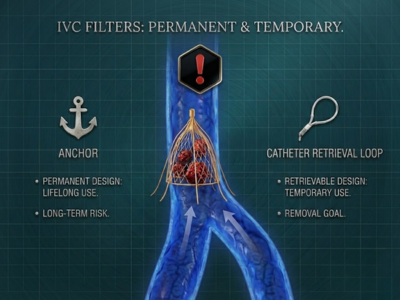
- Permanent IVC filters are designed to stay in your body for life. They’re typically reserved for patients with chronic, ongoing clotting risks — such as a long-term clotting disorder or recurring pulmonary embolism that hasn’t responded to medication. Once placed, they become a permanent part of your vascular anatomy.
- Retrievable IVC filters do exactly the same protective job — but they can be safely removed once the temporary risk has passed. If you had the filter placed because surgery made anticoagulation unsafe, or because of a trauma recovery, and you can now start blood thinners — the filter can come out. These are now the most commonly placed filters worldwide.
- Optional filters offer the best of both — they can remain permanently if circumstances require, but they also carry a defined retrieval window (usually several weeks to a few months after placement) during which removal is safe and technically straightforward.
The Real Risks and Benefits — An Honest Look at Both Sides
Any medical intervention worth taking seriously comes with both genuine benefits and real risks. IVC filters are no exception — and you deserve a straight answer on both fronts.
What the benefits actually look like
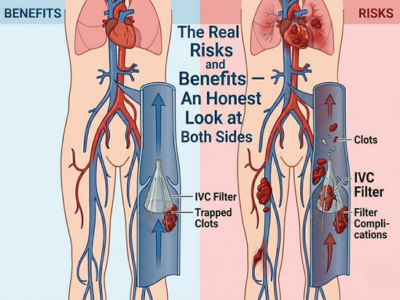
The primary benefit is clear and well-supported by clinical evidence: IVC filters significantly reduce the short-term risk of fatal pulmonary embolism in high-risk patients who cannot be anticoagulated. For a patient who is actively bleeding and has a confirmed DVT, the filter can be the difference between life and death. And for patients who receive retrievable filters, that protection doesn’t have to be a lifetime trade-off.
What the risks actually look like
- Filter thrombosis — a clot forming inside or around the filter itself, which can partially or fully block the IVC
- Filter tilt or migration — the device shifting position over time, potentially reducing its effectiveness
- IVC perforation — a rare but serious complication where filter struts gradually penetrate the vessel wall
- Retrieval difficulty — filters left in place significantly longer than recommended can become embedded in the vessel wall, making removal technically challenging or impossible
- Insertion site complications — minor bruising or a small haematoma at the entry point, which typically resolves without intervention
The key takeaway: Long-term outcomes with IVC filters are genuinely very good — when they are managed proactively. Retrievable filters retrieved on time, paired with anticoagulation wherever safe, and supported by regular follow-up imaging consistently show excellent results.
Where IVC Filter Technology Is Headed Next — The Future of Clot Prevention
Medicine doesn’t stand still, and the field of IVC filter design is evolving faster than most patients realise. Here’s a look at what’s coming — and in some cases, what’s already beginning to arrive.
- Bioabsorbable filters are among the most eagerly anticipated developments. These filters are made from materials that gradually dissolve inside the body after their protective job is done — essentially a filter that disappears on its own, with zero retrieval procedure required. Early research results are promising.
- Drug-eluting filters are being designed with built-in anticoagulant coatings that actively prevent clot formation on the filter surface itself — directly targeting one of the key complications of existing devices.
- Smart filter technology, still largely in the research phase, envisions devices with remote monitoring capabilities — filters that can alert your care team when a clot has been captured, or if the filter has shifted in any way.
- Next-generation retrieval systems are making it possible to safely remove filters that have been in place significantly longer than current guidelines permit — giving options back to patients who were previously told their filter could no longer be removed.
All of this points toward one direction: more personalized, precision-driven vascular care, with maximum protection and minimum long-term burden for every individual patient.
FAQs
How long does an IVC filter last in the body?
Can I have an MRI with an IVC filter?
Is the procedure painful?
Can I take blood thinners along with an IVC filter?
What happens if the filter catches a clot?
